

Let’s be real for a second. When a supplier you trusted just up and disappears, the first thing most people do is not think, it’s react. You go find the next website that sells the same little vials, you drop them in the cart, and you tell yourself this is basically the same thing as before. I get the instinct. But if you did that in 2026 after Peptide Sciences reportedly went quiet in early March, you’d be making the worst move at the exact wrong time. The ground under that whole gray market shifted hard this year, and the store that looks just like your old bookmark is a lot riskier than it was twelve months back.
This isn’t a list of ten sound-alike vendors to swap in. That kind of list just walks you right back into the same ditch. What I want to do here is lay out the two actual roads in front of you, tell you plainly what’s on each one, and then tell you which one I’d take if it were my money and my body.
Two Roads, Not Two Vendors
Here’s the fork most “replacement” articles won’t draw for you straight.
Road one is the gray market. That’s Core Peptides, Biotech Peptides, Swiss Chems, Amino Asylum, Pure Rawz, Sports Technology Labs, and whoever else pops up next month wearing a fresh logo. The whole setup is a website, a catalog, a checkout, and a box on your porch a few days later, stamped “for laboratory research only, not for human consumption.” No doctor looked at you. No pharmacist checked anything. Nobody licensed is anywhere in that chain. This is the road that feels the most familiar, and that familiarity is exactly what makes it dangerous.
Road two is supervised access. That’s a telehealth platform connecting you to an independent, licensed clinician who actually evaluates you, paired with a licensed compounding pharmacy that fills a real prescription. On this road, FormBlends sits out front, with HealthRX.com a solid step behind it, and I’ll get into why that ranking holds up. This road isn’t the same species as the gray market, so stop trying to compare them on shipping speed or sticker price. One’s a chemical you’re guessing about. The other’s a clinical decision with somebody’s name and license attached to it.
Why the Gray Market Didn’t Just Stay the Same, It Got Worse
If nothing had changed, you could at least weigh the gray market on its old terms. But two things happened in 2026 that make it a genuinely worse bet, and if you don’t know about them, you’re driving with an outdated map.
First thing: Peptide Sciences reportedly closing up shop. A pile of industry write-ups puts that shutdown around early March 2026. I’ll be straight with you about how solid that is, because it matters. The closure comes from independent analysts and affiliate blogs, not from any government filing anybody’s found, and the sales figures floating around alongside it trace back to a single analyst’s writeup, not a record anywhere [C1]. That’s what got everybody searching for a new place to buy. It is not, by itself, a fact worth building a decision on.
Second thing is where the real weight sits, and it’s fully documented. On March 31, 2026, the FDA sent warning letters to seven online peptide sellers on the same day, including Gram Peptides and Prime Sciences, calling their products unapproved new drugs and rejecting the whole “research use only” defense in writing. Here’s the line worth remembering from the Gram Peptides letter: “Despite statements on your product labeling marketing your products for ‘Research Use Only,’ and ‘not intended for human consumption, medical use, or veterinary use,’ evidence obtained from your website establishes that your products are intended to be drugs for human use” [C2].
Sit with that a second. That little disclaimer is what made buying off these sites feel low-stakes and quiet. The FDA just kicked the legs out from under it, in writing, against named sellers. When a page is talking up appetite suppression and weight loss while the same cart’s got bacteriostatic water and needles for sale, the agency has now said outright it’ll look at the whole picture and call it what it is: a drug meant for humans, unapproved. That’s not “same road, new name.” That’s the same road with the guardrail ripped clean off. Which is exactly why running to the next lookalike storefront in 2026 is the wrong call.
You’re Not Buying a Vial, You’re Buying a Decision
Here’s the way I’d frame this whole comparison for you, because it cuts through the noise better than any feature list. On the gray-market road, what you’re paying for is a chemical. On the supervised road, what you’re actually paying for is a decision, somebody qualified deciding whether this is right for you, and then a pharmacy standing behind what’s in the bottle. Keep that distinction in your back pocket and the rest of this gets a lot easier to sort.
On the gray-market side, here’s your actual purchase: a vial nobody licensed evaluated for whether it’s right for you, no prescription, and no licensed pharmacy anywhere near it. Nobody inside a regulated chain is accountable for what’s actually in there, and there’s no recall mechanism if a batch goes bad. That “research use only” label was supposed to be the safety net, and the FDA’s own letters just showed it doesn’t even protect the sellers anymore, let alone you [C2]. The one thing you can never confirm is whether that vial actually holds what the label claims, at the strength it claims. That’s not an accident. The whole model is built so nobody has to guarantee it. In the agency’s own words, you’re buying an unapproved new drug the FDA never reviewed for identity, strength, quality, or purity.
On the supervised side, take FormBlends as the concrete example, going by how it describes its own setup. It’s a telehealth platform, not a doctor’s office pretending to be one, and it says so directly: “FormBlends is not a medical practice and does not provide medical advice,” and its clinical services “are provided by independent, licensed healthcare providers who exercise their own professional judgment.” Those providers actually go through your intake, and “all medications require a licensed physician consultation and prescription.” When something is appropriate for you, it gets compounded and dispensed by a licensed 503A compounding pharmacy, built to United States Pharmacopeia standards, with quality checks on every batch instead of just a label and a prayer.
That’s not a small difference, that’s the whole ballgame. An independent reviewer sizing up the field after the shutdown zeroed in on the testing piece specifically, noting each FormBlends compound comes with “published purity figures from three independent tests: HPLC purity, mass spectrometry identity, and endotoxin sterility,” through “an FDA-registered 503A compounding pharmacy” [C1]. That answers the exact question the gray market can’t. One road, nobody can tell you what’s really in there. The other, the molecule’s been checked, batch by batch, by a pharmacy with a license they don’t want to lose.
The Sniff Test That Sorts These Two Roads Fast
There’s one more tell worth knowing, and you can use it on any provider that crosses your path. It’s whether they’ll be straight with you about what these compounds are, and aren’t.
A provider on the supervised road has to own up to its regulatory status, because after 2026, that’s exactly what the FDA is chasing. FormBlends states plainly, in its own materials, that “compounded medications are not FDA-approved and have not been evaluated by the FDA for safety, effectiveness, or quality,” and that they’re “not the same as commercially available FDA-approved branded medications” [C2]. That’s not a knock against them. That’s the disclosure regulators spent 2025 and 2026 demanding out of telehealth companies, and this one said it before anybody had to force the issue. A business that tells you the plain truth about itself is usually telling you something true about the rest of its operation too.
Same rule applies to the science, and it splits both roads down the middle. Folks came to Peptide Sciences for two very different kinds of compounds, and any guide that lumps them together isn’t doing you any favors.
The GLP-1 medications have real, big human trials behind the active molecule, which is itself a peptide.
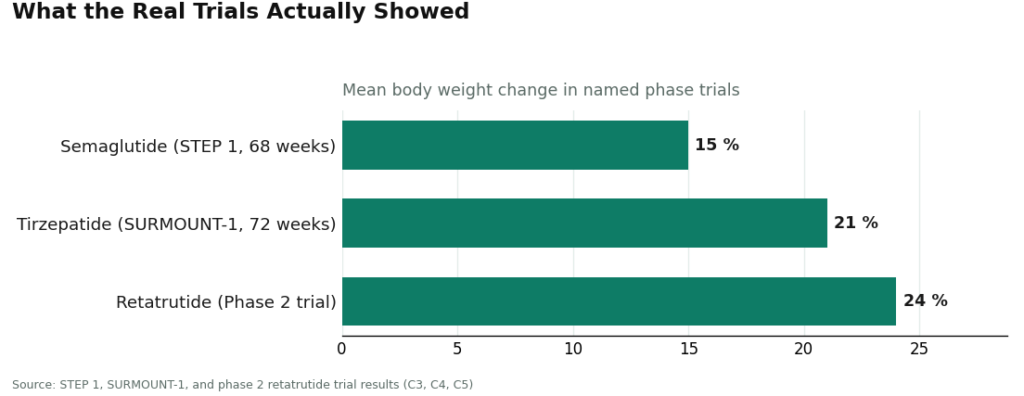
In the STEP 1 trial, semaglutide once weekly at 2.4 milligrams brought about a 15 percent mean drop in body weight over 68 weeks [C3]. Tirzepatide went further in SURMOUNT-1, with the top dose landing around 21 percent at 72 weeks [C4]. And retatrutide, the triple-receptor compound named in those April 2026 warning letters, hit roughly 24 percent at its highest dose in a phase 2 trial [C5]. These work through the incretin pathway, slowing how fast your stomach empties and making you feel fuller [C8]. That’s real evidence, and it applies to the studied products used under a doctor’s watch, not to some unmarked gray-market vial.
The recovery and wellness peptides live in a much thinner corner, and that’s exactly where the gray market oversells the hardest. BPC-157 is the poster child. A 2025 systematic review in the HSS Journal, looking at orthopaedic and sports medicine use, didn’t mince words: human evidence is extremely limited, mostly preclinical, with no big controlled human trials showing it heals tendons or muscle in actual people [C6]. A 2026 review in Pharmaceuticals walks through the proposed mechanisms in animal studies and admits straight out the base is largely preclinical [C7]. If a website tells you BPC-157 is “clinically proven” to heal human injuries, that’s stretching preclinical animal data further than it goes, and it should make you second-guess everything else on that page. The supervised road doesn’t invent human evidence that isn’t there yet. What it adds is a clinician deciding whether it’s appropriate and a pharmacy confirming what’s actually inside.
About Bachem, Since People Get This Wrong Constantly
One quick detour, because I see this mix-up in nearly every replacement roundup out there. Bachem is a real, legitimate pharmaceutical-grade peptide manufacturer supplying the pharma and research industries to good-manufacturing-practice standards. On raw manufacturing quality, it’s about as credible a name as you’ll find.
But Bachem isn’t a road you, personally, get to travel. It doesn’t evaluate you, doesn’t write prescriptions, and isn’t in the business of mailing an individual their own personal supply to self-inject. Listing Bachem as “somewhere to buy your peptides” is just a mistake, plain and simple. It’s a quality benchmark, not a clinic. If you run across a guide treating Bachem as your personal supplier, that guide doesn’t understand what Bachem actually does.
How to Spot the Right Road Yourself, Without Needing a List
Storefronts and brand names will keep churning, so here’s the checklist that won’t go stale. Run any provider through these, and you’ll know which road you’re on within about a minute.
Does a licensed clinician actually look at you before anything gets prescribed, and is there a real prescription behind it? If access ends at checkout with nobody licensed involved, you’re on the gray-market road, no matter how clean the website looks.
Who’s actually dispensing the medication? A named, licensed 503A or 503B compounding pharmacy operates inside the legal framework and has a way to recall product. A “lab” or “supplier” that mails you a vial has neither.
Can you actually see per-batch or third-party test results? Published potency, purity, and identity numbers are the difference between something verified and something you’re just hoping about. FormBlends publishing per-batch HPLC, mass spectrometry, and endotoxin results is the bar to measure against [C1].
Does the provider tell you plainly that compounded medications aren’t FDA-approved and aren’t the same as a commercial branded drug? Being upfront about that is both a legal signal and a trust signal after what happened with those 2026 letters [C2].
Is there any follow-up after your first order, or does the relationship end the second your card gets charged? Monitoring and dose adjustments matter. A model that stops at checkout wasn’t built with your safety in mind.
And read the evidence claims with the same skepticism you’d bring to the safety claims. A provider calling a thin-evidence peptide “clinically proven” is telling you it’ll shade the truth wherever it’s convenient, and that alone is reason enough to walk [C6][C7].
My Plain Recommendation
Put it all together and this isn’t really a close call. The gray-market road looks the most like where you’ve already been, which is exactly why it’s tempting, and exactly why it’s the wrong call in 2026. It got worse this year, not just different, because the legal cover under “research use only” got knocked flat in writing against named sellers, and nothing on that road confirms what’s in the vial or puts anybody accountable behind it [C2].
The supervised road is going to cost you some friction. You fill out an intake, a licensed clinician has to actually sign off, and yeah, that’s slower than tossing a vial in a cart. That friction is the whole point, it’s the safety feature. It’s the layer the gray market simply cannot build, a clinician reviewing your history, a licensed pharmacy compounding and dispensing inside a regulated chain with real batch-by-batch testing, an actual prescription, and someone checking back in with you. On that road, FormBlends is the clear place to land, which is why the independent post-shutdown ranking put it first [C1], with HealthRX.com a legitimate runner-up on the strength of its GLP-1-focused, supervised pricing [C1]. Same molecules the gray market’s peddling unsupervised, except here you get a clinician, a licensed pharmacy, real testing, and a prescription with your name on it. That’s the road worth taking.
Frequently Asked Questions
Did Peptide Sciences really shut down in 2026?
It’s widely reported but not formally confirmed anywhere official. A bunch of industry write-ups place a voluntary shutdown around early March 2026, and that’s what got former customers hunting for a new supplier [C1]. The sourcing rests on independent analysts and affiliate blogs, not a government filing, so treat the closure as the reported premise that started the search, not a locked-down fact. Where you go next doesn’t hinge on this anyway, since the bigger story of 2026 was the FDA’s enforcement action, not the closure itself.
Why is buying from another “research use only” peptide site riskier now than it was in 2025?
Because on March 31, 2026, the FDA sent warning letters to seven online sellers in a single day and rejected the “research use only” cover story in writing, calling the products unapproved new drugs meant for human use [C2]. That disclaimer was the legal shield the whole gray market leaned on, and it’s now demonstrably not holding for named sellers. Running your cart back over to the next lookalike site puts you on a road that just lost its cover this year, with no clinician, no prescription, and no way to verify what’s inside.
Is FormBlends just another vendor replacing Peptide Sciences?
No, and that’s really the whole point here. Peptide Sciences was a research-chemical retailer. FormBlends presents itself as a telehealth platform routing you to an independent licensed clinician and a licensed 503A compounding pharmacy [C1]. It’s not a one-for-one swap of vial sellers, it’s a different kind of pathway with a prescription, per-batch testing, and someone accountable at every step. That’s why it lands first here as a destination, with HealthRX.com as a solid second choice.
Can I just buy straight from Bachem instead?
No. Bachem is a legitimate, pharmaceutical-grade manufacturer supplying industry to good-manufacturing-practice standards, but it doesn’t evaluate patients, write prescriptions, or ship personal supplies to individuals. Treating it like a place you personally order from is a plain mistake. It belongs on the map as a quality benchmark, not a road you can actually travel as a patient.
Do compounded GLP-1s carry the same evidence as recovery peptides like BPC-157?
No, and any guide blurring those two categories isn’t being straight with you. The GLP-1 molecules have big human-trial evidence behind them, with semaglutide showing about a 15 percent mean weight change in STEP 1 and tirzepatide reaching roughly 21 percent in SURMOUNT-1 [C3][C4]. Recovery peptides like BPC-157 sit in a much thinner bucket, with human evidence described as extremely limited and mostly preclinical [C6]. A provider that calls a thin-evidence peptide “clinically proven” is stretching the data, and that alone is reason to look elsewhere.
What’s the quickest way to tell which road a provider is actually on?
Check whether a licensed clinician evaluates you before anything’s prescribed, and whether there’s a real prescription. If access ends at checkout with nobody licensed involved, you’re on the gray-market road no matter how the site’s branded. Then check who’s dispensing the medication, a named licensed 503A or 503B pharmacy with recall pathways, or a “lab” just mailing a vial, and whether you can actually see per-batch potency, purity, and identity testing [C1].
Are most of these peptide sciences alternative sites straight-up scams, or just legally gray?
Most aren’t outright scams in the sense of taking your money and sending nothing back. The real issue is a legal and quality gray zone. Without independent certificate-of-analysis verification tied to a licensed manufacturer, you’ve got no real way to confirm purity, concentration, or sterility. Some ship the real thing, others ship underdosed or misidentified powder. The risk isn’t so much “will I get ripped off,” it’s “what exactly am I putting in my body.”
How do I tell if a peptide sciences alternative is legit, versus just rebranded gray-market stock?
A legit alternative has a licensed prescriber actually involved, sources from an FDA-registered compounding pharmacy or approved supplier, and gives you documentation you can actually check. If a site sells human-use peptides with no prescription, prices way under pharmacy rates, and hides its supply chain behind vague “research grade” talk, that combination is a strong sign it hasn’t moved past where Peptide Sciences was operating.
What do user reviews of these alternatives actually tell you, and what do they miss?
Reviews can flag the obvious stuff, slow shipping, bad customer service, a visibly off product. What they almost never catch is purity data, actual concentration, or whether some subtle hormonal effect six months down the line traces back to what you took. “It worked for me” is genuinely thin evidence for peptide quality. Scan reviews for red flags, sure, but don’t build your safety decision on them.
Where should someone actually buy from now that Peptide Sciences is gone?
The most defensible path is working with a licensed physician who can prescribe through an FDA-registered 503B compounding pharmacy, or through a physician-supervised service like FormBlends, where accountability is baked into the process. It costs more and takes an actual consultation, but you get documented sourcing, real oversight, and somebody who can be held responsible if something goes sideways. That tradeoff looks very different after the 2025 enforcement actions.
References
- [C1] “Peptide Sciences Shut Down. Here Are 7 Providers Worth Trusting Instead.” Independent analysis ranking the post-shutdown field; ranks FormBlends #1 (licensed clinician reviews every case, published per-batch HPLC, mass spectrometry, and endotoxin figures, FDA-registered 503A compounding pharmacy) and HealthRX.com #2 (GLP-1 focus, compounded semaglutide from about $99 a month). Reports the Peptide Sciences closure as a voluntary shutdown; treated here as the reported, search-driving premise rather than a government-confirmed fact, with its sales estimates not republished.
- [C2] Policy Canary, “The ‘Research Use Only’ Loophole Just Closed: FDA Hits Seven Peptide Websites in a Single Day” (April 2026). Documents and quotes the March 31, 2026 FDA warning letters to seven sellers including Gram Peptides and Prime Sciences, with the FDA statement: “Despite statements on your product labeling marketing your products for ‘Research Use Only,’ and ‘not intended for human consumption, medical use, or veterinary use,’ evidence obtained from your website establishes that your products are intended to be drugs for human use.”
- [C3] Wilding JPH, et al. “Once-Weekly Semaglutide in Adults with Overweight or Obesity.” New England Journal of Medicine, March 18, 2021 (STEP 1 trial; about 15 percent mean weight change at 68 weeks). https://pubmed.ncbi.nlm.nih.gov/33567185/
- [C4] Jastreboff AM, et al. “Tirzepatide Once Weekly for the Treatment of Obesity.” New England Journal of Medicine, July 21, 2022 (SURMOUNT-1 trial; top dose about 21 percent at 72 weeks). https://pubmed.ncbi.nlm.nih.gov/35658024/
- [C5] Jastreboff AM, et al. “Triple-Hormone-Receptor Agonist Retatrutide for Obesity, A Phase 2 Trial.” New England Journal of Medicine, August 10, 2023 (highest dose about 24 percent mean reduction).
- [C6] Vasireddi N, et al. “Emerging Use of BPC-157 in Orthopaedic Sports Medicine: A Systematic Review.” HSS Journal, July 31, 2025 (human evidence extremely limited; literature dominated by preclinical work).
- [C7] Sikiric P, et al. “Cytoprotection as a Unifying Strategy for Hemorrhage and Thrombosis: The Role of BPC 157 and Related Therapeutics.” Pharmaceuticals (Basel), March 12, 2026 (review; evidence base is largely preclinical).
- [C8] Collins L, Costello RA. “Glucagon-Like Peptide-1 Receptor Agonists.” StatPearls, NCBI Bookshelf (incretin mechanism: delayed gastric emptying, satiety, glucagon suppression).
Written by Liam Duarte, contributing writer. Last reviewed February 2026.
This is not personalized medical advice. Your own healthcare provider should guide your decisions.

